7 Steps for Executive Financial Planning During a Career Transition
Last Updated: November 12, 2026
Quick Summary
Executive financial planning during a career transition is the process of coordinating income, equity, benefits, retirement accounts, and taxes before, during, and after a major job change. It differs from general planning because a single decision, such as when to exercise options or how to time a bonus, can move several parts of your financial picture at once.
- Start with a written snapshot of assets, liabilities, income sources, and near-term goals before evaluating any offer.
- Model your income gap month by month using fixed expenses, discretionary spending, and confirmed income.
- Review severance terms line by line before signing, since payment structure and benefit end dates lock in.
- Sort every equity award into exercise or sell, hold and decide, or accept forfeiture.
- Confirm end dates for life insurance, disability coverage, and executive health programs, which rarely continue automatically.
Why Executive Financial Planning During a Career Transition Needs Its Own Roadmap
Executive financial planning during a career transition is the process of coordinating income, equity, benefits, retirement accounts, and taxes before, during, and after a major job change. For broader context on managing executive wealth, see our wealth management guide for corporate executives.
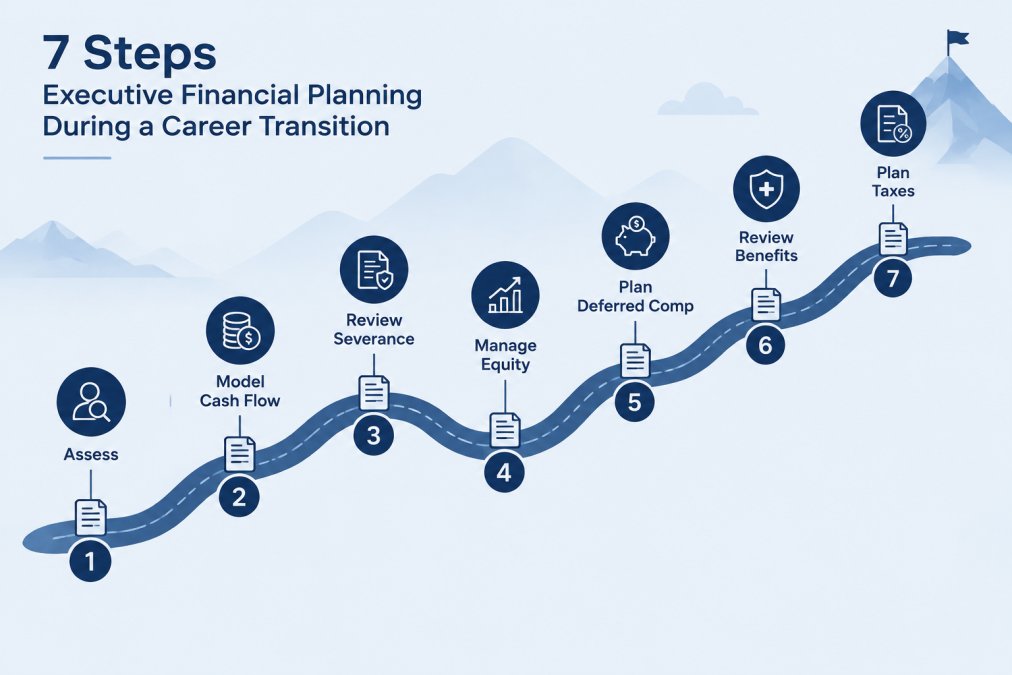
Below, we walk through seven steps, in order, so you can see what to gather, what to model, and what to review before you sign anything.
Step 1: Assess Your Current Financial Situation and Goals
Start with a written snapshot of where you stand today. That means listing assets, liabilities, income sources, and your near-term goals before you evaluate any offer or exit package.
A career change rarely affects one account. It touches cash flow, retirement savings, and your long-term goals all at once. Getting the snapshot down on paper first keeps later decisions grounded in facts rather than urgency.
Documents to Gather Before You Decide Anything
- Recent account statements for every retirement and brokerage account
- The current summary plan description for your 401(k) and any pension
- Equity award agreements, including vesting schedules and grant dates
- Your most recent deferred compensation election form
- The current benefits enrollment guide, including health insurance options
- Prior two years of tax returns
- Any proposed severance or offer letter, in draft form
Step 2: Model Your Cash Flow and Income Gap
An income gap is the period between your last executive paycheck and the first reliable income from your next role.
Build the model in three columns: fixed expenses, discretionary spending, and confirmed income. Fixed expenses generally include housing, insurance premiums, and debt payments. Discretionary spending covers travel, dining, and other flexible categories you can pause if needed.
Then map the timeline. A typical executive transition has four phases: the months before departure, the notice period, the severance window, and the first months in the new role.
Watch out: a frequent mistake is counting a bonus or equity vest as confirmed income before the payment date is fixed.
Step 3: Review Severance, Bonuses, and Transition Benefits
Severance review is where an executive transition most often becomes irreversible. Once a separation agreement is signed, the payment structure, release of claims, and benefit end dates are generally locked. Reading the package line by line before responding is an important step in the process.
A Pre-Signature Review Checklist
Work through the agreement in this order, because later items often depend on earlier ones:
- Payment structure. Is severance paid as a lump sum, salary continuation, or a combination? Each arrives on a different timeline and may land in a different tax year.
- Release and timing. Separation agreements typically include a release of claims and a revocation period. The date you sign can affect when payments begin.
- Bonus treatment. Confirm whether the annual bonus is prorated, forfeited, or paid at target versus actual performance. Ask how the plan document defines “employed on the payment date.”
- Equity acceleration. Identify whether any unvested awards vest early under the agreement, and whether that acceleration is discretionary or contractual.
- Health coverage. Note the end date of active coverage and whether the employer subsidizes COBRA continuation, and for how long.
- Deferred compensation. Confirm how the separation triggers distribution under the plan’s election terms (covered in Step 5).
- Non-compete, non-solicit, and clawback terms. These can affect your next role and any incentive pay already received.
- Outplacement and transition services. These are sometimes negotiable and rarely priced into the cash analysis.
The Negotiation Window
A common pattern is that the first offer is a starting point, not a final one. Executives often have more room to negotiate on timing, bonus proration, and equity acceleration than on the headline severance amount.
According to Morgan Stanley at Work’s guidance on executive transitions, equity awards, 401(k) accounts, and other workplace benefits are key considerations during a transition. That list is a useful starting checklist, but the agreement itself is where the specifics live.
Mapping Severance to the Income Gap
The severance payment is not the same as your runway.
Watch out: counting a prorated bonus or an accelerated vest as confirmed income before the agreement is signed and the payment date is fixed is a frequent modeling error in this step.
Tax rules change, and outcomes vary by individual circumstances. The timing questions raised here are worth reviewing with a tax professional before you sign.
The pre-signature review checklist covers these terms, in this order.
|
Term |
What to confirm |
|---|---|
|
Payment structure |
Lump sum, salary continuation, or a combination |
|
Release and timing |
Release of claims and revocation period; signing date affects payment start |
|
Bonus treatment |
Prorated, forfeited, or paid at target versus actual performance |
|
Equity acceleration |
Whether unvested awards vest early, discretionary or contractual |
|
Health coverage |
Active coverage end date and any COBRA subsidy and duration |
|
Deferred compensation |
How separation triggers distribution under election terms |
|
Non-compete and clawback |
Non-compete, non-solicit, and clawback terms affecting next role |
|
Outplacement services |
Sometimes negotiable and rarely priced into the cash analysis |
Step 4: Executive Equity Compensation Management and Vesting Schedules
Executive equity compensation management is the practice of coordinating stock options, restricted stock units, and performance awards around vesting dates, tax treatment, and concentration risk. A vesting schedule sets when each award becomes yours, and that schedule often drives the timing of an entire transition.
Know Which Award Type You Hold
The tax and timing rules differ by award type, so the first task is a written inventory of every grant:
- Incentive stock options (ISOs). These can carry special tax treatment if holding periods are met, and they are subject to annual limits under federal tax law. The exercise window after departure is often short.
- Nonqualified stock options (NSOs). These are more common at the executive level and are generally taxed as ordinary income on the spread at exercise.
- Restricted stock units (RSUs). These typically settle in shares at vest, and their tax treatment depends on plan terms and individual circumstances.
- Performance shares and performance units. These depend on metrics and a vesting date, and the plan document governs what happens on separation.
- Restricted stock. These may carry an 83(b) election made at grant, which changes the tax picture at vest and at sale.
For each grant, note the grant date, vesting schedule, exercise price, expiration date, and what the plan says happens on a qualifying versus non-qualifying separation.
The Departure Decision Tree
The key distinction is between awards that are vested and unvested at departure:
- Vested options. These usually carry an exercise window after you leave, and that window can be shorter than you expect, commonly 90 days for ISOs, though plan terms vary. Miss it and the options may expire worthless.
- Unvested awards. These may be forfeited unless the plan or a negotiated agreement says otherwise. This is where the severance negotiation from Step 3 connects directly to equity.
- Vested shares already held. These are yours, but the sale timing and tax treatment of gains still matter.
A practical framework is to sort every award into one of three buckets: exercise or sell before departure, hold and decide during the exercise window, or accept forfeiture. Then model the cash needed to exercise against the runway from Step 2.
Concentration Risk and the Sale Decision
When a large share of your net worth sits in one company’s stock, the timing of sales and the tax treatment of gains both matter.
Watch out: exercising options without checking the alternative minimum tax (AMT) implications of ISOs, or selling shares without confirming holding periods, can create a tax result that is difficult to unwind.
For a deeper look at how we approach this work, see our corporate executive planning services.
Step 5: Deferred Compensation Planning for Executives
Deferred compensation planning for executives involves deciding how to handle nonqualified deferred compensation balances when you change roles.
Review three things: the distribution schedule, the form of payment, and whether the plan allows you to change elections. Some plans permit limited changes, and the deadlines are strict. Others lock the schedule in place once made.
A large deferred balance paid out in a single year can stack on top of severance and bonus income. For a broader framework, read our article on how corporate executives manage their wealth.
Step 6: Retirement Accounts, Health Insurance, and Workplace Benefits
For the 401(k), the usual choices are leaving it in place, rolling it to an IRA, or moving it to a new employer’s plan.
Health insurance is often a significant new expense in the gap. Options generally include COBRA continuation, a spouse’s plan, or a marketplace plan (FAQs on COBRA Continuation Health Coverage for Workers).
Also confirm end dates for life insurance, disability coverage, and any executive health program. These benefits rarely continue automatically.
Step 7: Tax-Efficient Career Transition Strategies
Tax-efficient career transition strategies aim to spread income across tax years and coordinate the timing of severance, bonuses, and equity events. Tax rules change, and outcomes vary by individual circumstances.
The core idea is sequencing. If a large equity vest and a severance payment land in the same year, the combined income may push you into a higher bracket. Shifting one event into a different year, where the plan rules allow it, may reduce that effect for some individuals.
A Hypothetical Scenario for Illustration Only
Consider a hypothetical executive with a base salary, a target bonus, and unvested options scheduled to vest in March. She receives an offer in January with a start date in April.
For a deeper walkthrough of the concepts in this step, see our guide on how to reduce retirement tax liability. When you are ready to talk through your own situation, you can schedule a meeting with our team.
A career transition gives you a rare window to reset how income, equity, and retirement savings fit together.
This content is for educational purposes only and is not intended as personal tax, legal, or investment advice. Individual circumstances vary; consider speaking with a qualified professional.
Frequently Asked Questions
What financial documents should an executive review before a career transition?
Gather recent tax returns, pay stubs, brokerage and retirement account statements, equity award agreements with vesting schedules, deferred compensation plan documents, and current benefit elections including health insurance. Also collect any severance or transition agreement drafts. Reviewing these before accepting a new role or resigning helps clarify your income gap, vesting dates, and tax exposure. Equity awards, 401(k) accounts, and workplace benefits are generally key considerations during a transition. Consider speaking with a qualified professional before signing anything.
How might equity compensation be handled during a career change?
Equity compensation management during a transition generally starts with the vesting schedule. Unvested options or restricted stock units often have specific treatment on departure, and some plans allow accelerated vesting or extended exercise windows. Exercising options can create ordinary income or capital gains consequences depending on the plan type and holding period. Tax rules change, and outcomes vary by individual circumstances. Review your award agreements and plan documents carefully, and consider professional guidance before making exercise or forfeiture decisions.
What are the potential tax implications of changing executive roles?
Severance, bonuses, deferred compensation payouts, and equity exercises may each carry different tax treatment. A large one-time payout could push you into a higher bracket for that year, and some deferred compensation elections have fixed payout schedules. Tax-efficient career transition strategies often involve spreading income, timing equity exercises, and coordinating with retirement account contributions. Tax rules change, and outcomes vary by individual circumstances. Consider reviewing projected income with a tax professional before finalizing transition terms.
Should I consider a fiduciary advisor during a career transition?
A fiduciary advisor is generally required to act in your best interest and disclose potential conflicts. During a transition, that standard may matter when evaluating equity decisions, rollover options, and income timing. Ask any professional about their fiduciary status, scope of services, and how they are compensated before engaging them. Oxford Advisory Group works with executives on these questions; consider scheduling a consultation to explore how these principles may apply to your situation.

Ready to Take The Next Step?
For more information about any of the products and services listed here, schedule a meeting today or register to attend a seminar.
