Social Security for Government Employees: What to Know
Last Updated: November 24, 2026
Quick Summary
Social security benefits for government employees depend on the retirement system behind the job, such as FERS or CSRS for federal workers, or mandatory coverage or a Section 218 agreement for state and local workers. Benefits are based on your earnings record, so years of non-covered service can change the outcome. The Social Security Fairness Act repealed the WEP and GPO reductions that once affected some public retirees.
- Federal employees’ coverage depends on whether their work falls under CSRS, FERS, or another federal system.
- State and local workers may be covered through mandatory coverage or a Section 218 agreement.
- The Social Security Fairness Act repealed the WEP and GPO, and signed on January 5, 2025.
- Check your online my Social Security account and SSA notices for the current status of your record.
- Confirm your position’s coverage status with your employer or retirement system before assuming either way.
How Social Security Coverage Works for Government Employees
Many public workers wonder whether their service counts toward Social Security at all. The answer depends on the type of job and the retirement system behind it.
Most U.S. workers are covered by Social Security. According to the U.S. Government Accountability Office report on public-employee coverage, about 96% of U.S. workers were covered, and most workers outside coverage were government employees.
Coverage is not automatic for every public job, though. Here is what generally determines it:
- Federal employees: Coverage depends on whether the work falls under the Civil Service Retirement System or another federal retirement system.
- State and local employees: Coverage may come from mandatory coverage or a Section 218 agreement.
- Work history: Benefits are based on your earnings record, so non-covered years can change the picture.
Ask your employer or retirement system whether your position is covered before you assume either way.
Federal Retirement Systems: FERS and CSRS Compared
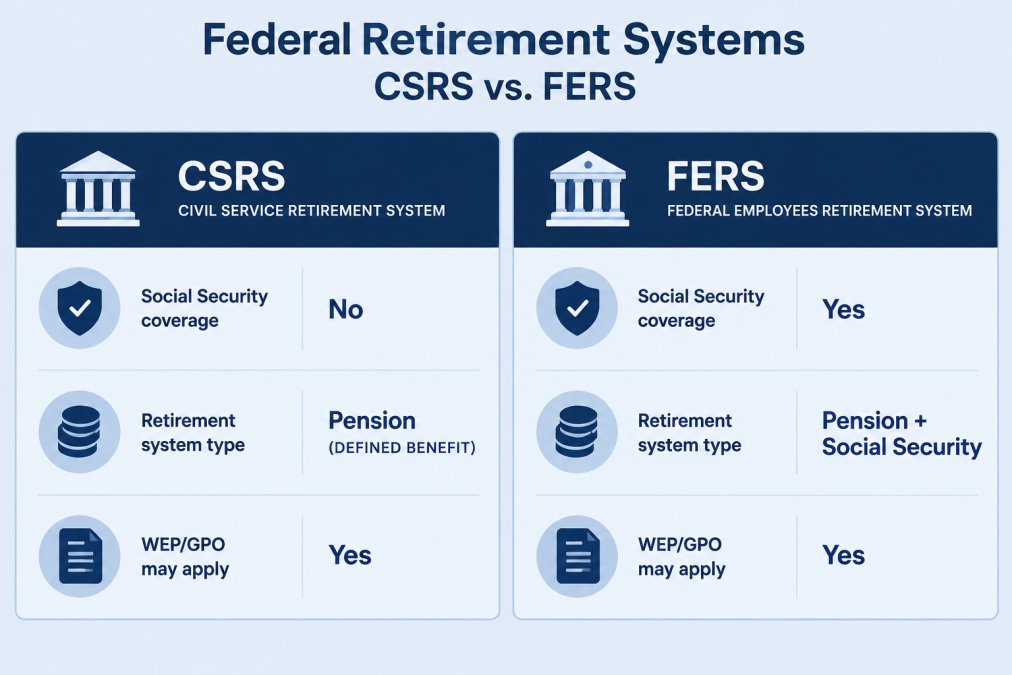
Federal workers usually fall under one of two systems. The table below gives a simple overview. Coverage details can vary, so confirm your own status.
|
System |
Social Security Coverage |
Common Feature |
Who It Often Applies To |
|---|---|---|---|
|
FERS |
Generally covered |
Pension plus Social Security and a savings plan |
Most newer federal employees |
|
CSRS |
Often not covered |
Pension without Social Security for that service |
Many employees hired before 1984 |
The Social Security Administration guidance for federal workers explains that eligibility depends on which system covered your work.
Because these systems differ, two federal employees with similar salaries may have very different Social Security outcomes. A personal review of your work history is often a helpful first step.
State and Local Government Employee Coverage
State and local workers are covered differently. Coverage may depend on the arrangement your employer made with the government. The Social Security Administration publication on state and local employee coverage describes how these arrangements work.
Teachers, firefighters, and police officers are common examples. Some of these jobs have Social Security coverage, while others do not. Your plan documents and pay records usually show which applies.
The IRS guidance on state and local employee coverage notes that employees may have Social Security and Medicare coverage through either mandatory coverage or a Section 218 agreement.
How a Government Pension Interacts With Social Security
A government pension can affect the Social Security benefit you receive when you have also worked in covered jobs. Two rules are often discussed: the Windfall Elimination Provision and the Government Pension Offset.
Windfall Elimination Provision (WEP) and Government Pension Offset (GPO)
The Windfall Elimination Provision (WEP) changed how Social Security benefits were calculated for people with pensions from non-covered work. The Government Pension Offset (GPO) affected spousal and survivor benefits for some government retirees.
Both rules are now different in effect because of recent changes. Review your own situation rather than relying on general rules.
What the Social Security Fairness Act Changed for Public Employees
The Social Security Fairness Act repealed the WEP and the GPO. The law was signed on January 5, 2025. Check the official Social Security Administration source for the effective dates that apply to your benefit. The Social Security Administration publishes information on the repeal and how it is being implemented.
What changed in practice
- Own retirement and disability benefits. For people whose benefits had been reduced by the WEP, the SSA recalculated the benefit using the standard formula without the WEP reduction, effective for months after December 2023.
- Spousal and survivor benefits. For people whose spousal or survivor benefits had been reduced or zeroed out by the GPO, the SSA recalculated those benefits without the GPO offset, effective for months after December 2023.
- Retroactive payments. Some affected beneficiaries may be due back payments; the official Social Security Administration source describes how these are handled.
Implementation timeline to watch
The SSA has described a phased approach. The SSA has described its implementation in general terms. The steps below summarize that general approach:
- Identification. The SSA identified beneficiaries whose records showed a non-covered pension and who had received a WEP-reduced or GPO-reduced benefit.
- Recalculation. The agency recalculated affected benefits without the WEP or GPO reduction.
- Retroactive payment. Back payments, where due, are issued under the SSA’s process, with the updated monthly amount continuing afterward.
- Ongoing review. Cases with incomplete pension information, foreign pensions, or complex earnings records have generally taken longer to process.
Because processing timelines have varied by case, the SSA has encouraged beneficiaries to check their online account and their mailed notices for the current status of their record rather than relying on general timelines. Checking notices also helps beneficiaries plan around any taxable Social Security income.
What to do if you think your record may be affected
- Check your online account. The SSA’s my Social Security account may show your current benefit information and any recent notices.
- Review your notices. The SSA has mailed notices to affected beneficiaries describing the new benefit amount and any retroactive payment.
- Confirm your pension status. If you are unsure whether your pension was treated as non-covered, your pension administrator can confirm the plan’s coverage status.
- Keep records. Retain copies of SSA notices, pension statements, and W-2 forms showing covered and non-covered years; these are often useful if a record needs to be corrected.
- Contact the SSA for case-specific questions. General rules may not match a specific record, especially where foreign pensions, federal service under CSRS, or mixed covered and non-covered work are involved.
Watch out: a retroactive payment does not necessarily mean the record is fully settled, if the SSA later corrects an earnings or pension entry, the monthly amount may be adjusted again.
What did not change
The repeal addressed the WEP and GPO reductions. Coverage rules for federal, state, and local employees are set by separate provisions, and you should confirm your own status with the official source.
Tax rules change, and outcomes vary by individual circumstances.
Checking Your Own Social Security Benefit Situation
A simple review can help you understand where you stand:
- Gather your Social Security statement and your pension estimate.
- Confirm whether each job you held was covered by Social Security.
- Note the years of non-covered service and any covered earnings.
- Review how a benefit estimate changes if you retire at different ages.
The Social Security Administration statistical snapshot shows national program figures, which can give context, though they are not specific to government employees.
Tax rules change, and outcomes vary by individual circumstances.
Planning Next Steps With a Qualified Professional
Social Security rules for government employees can be complicated, and your outcome depends on your work history, pension, and family situation. Reviewing your records with a qualified professional may help you see how these pieces fit together.
Consider scheduling a consultation to explore how a government pension and Social Security may apply to your situation. Read our guide on how Social Security works alongside other retirement income to see the broader picture, and see how retirement taxes may affect your income before you decide.
This content is for educational purposes only and is not intended as personal tax, legal, or investment advice. Individual circumstances vary; consider speaking with a qualified professional.
Consider scheduling a consultation to explore how these principles may apply to your situation.
Frequently Asked Questions
Do federal employees receive full Social Security benefits?
Federal employees hired under the Federal Employees Retirement System (FERS) generally pay Social Security taxes and may earn benefits based on their covered work history. Employees under the older Civil Service Retirement System (CSRS) may have had little or no Social Security coverage for federal service, depending on their history. Whether an individual receives full benefits depends on total covered earnings and the number of years worked in covered employment. Your Social Security earnings record at ssa.gov is a helpful place to check how your benefit may be affected.
Can you receive both a government pension and Social Security?
In many cases, yes. Many government employees receive a public pension and Social Security retirement benefits. However, if the pension is based on work not covered by Social Security, the Windfall Elimination Provision (WEP) or Government Pension Offset (GPO) may have reduced Social Security benefits in the past. The Social Security Fairness Act repealed these provisions. Check the official Social Security Administration source for effective dates. Outcomes vary by individual circumstances, so reviewing your specific work and pension history is generally a helpful starting point.
Might the Social Security Fairness Act affect public employees with pensions?
The Social Security Fairness Act, signed January 5, 2025, repealed the Windfall Elimination Provision and Government Pension Offset. The Social Security Administration publishes the applicable effective dates. Public employees with pensions from non-covered work may be affected, potentially including changes to benefit calculations. The Social Security Administration publishes guidance on how these changes apply, and individual situations may differ.
Should I consider consulting a professional about my government pension and Social Security?
Consider speaking with a qualified professional if your government pension, work history or coverage status is complex. Coverage rules differ across federal, state and local employment, and records may need to be verified. A professional may help you organize relevant documents, review your Social Security earnings record and understand how your pension may interact with benefits. This content is for educational purposes only and does not replace individualized guidance.

Ready to Take The Next Step?
For more information about any of the products and services listed here, schedule a meeting today or register to attend a seminar.
