Charitable Giving Strategies for Business Owners: A Planning Guide
Last Updated: November 28, 2026
Quick Summary
Charitable giving strategies for business owners generally start with deciding whether the gift comes from the business or from you personally, since each follows different deduction rules and limits. Cash, appreciated stock, and privately held business interests each carry their own treatment, so the asset choice often matters as much as the amount.
- A personal gift and a business gift are separate taxpayers and generally follow separate rules.
- Pass-through entities typically state contributions separately on Schedules K-1 for owners to claim.
- A C corporation may deduct qualifying contributions on its own return, subject to the corporate limit.
- Giving long-term appreciated assets may be more tax-efficient than selling and giving cash.
- A contemporaneous written acknowledgment is generally required for gifts of $250 or more.
Why Charitable Giving Needs a Strategy, Not Just a Check
Charitable giving strategies for business owners start with one idea: a gift made through the business follows different rules than a gift made from your personal account. According to IRS guidance on charitable contributions, a donation generally needs a qualified charity, a proper record, and the right tax treatment to count.
The how matters as much as the how much: cash, stock, and business interests each carry their own rules.
Personal Gifts vs. Business Gifts: Two Different Sets of Rules
A personal gift comes from you. A business gift comes from the entity. Those are separate taxpayers, and they generally follow separate rules.
- Personal gifts may be deductible on your individual return, subject to limits based on your income.
- Business gifts may be deductible at the entity level, subject to the entity’s own limits, which depend on the entity’s tax classification.
- Mixing the two is a common error. A payment from the company account recorded as a personal gift creates a paper trail that is hard to defend.
If you own the business, this distinction shapes everything that follows. For owners weighing how giving fits into a wider plan, our financial planning for business owners and entrepreneurs page outlines the areas we typically review together.
Business Charitable Donations: How Entity-Level Deductions Generally Work
Entity-level deductions are deductions a business takes on its own return for contributions it makes directly. The entity claims the gift, not the owner. That sounds simple, but the answer to "who claims the deduction and subject to what limit" generally turns on the entity’s tax classification.
How Treatment Generally Differs by Business Structure
The IRS treats each entity type as a separate taxpayer with its own return and its own charitable contribution rules. According to IRS guidance on charitable contributions, a contribution generally needs a qualified recipient and proper substantiation to be deductible, and the deduction limit is typically tied to the taxpayer’s contribution base.
- Sole proprietorship. The business is generally not a separate taxpayer. A contribution made from the business is often reported on the owner’s individual return, typically on Schedule C or as an itemized charitable deduction, and the owner’s individual limits generally apply. The practical question is whether the gift was a business expense or a personal contribution, and the records should make that clear.
- Single-member LLC. By default, a single-member LLC is generally disregarded for federal tax purposes, so treatment often follows the sole proprietor pattern unless the LLC elects corporate treatment. Multi-member LLCs typically follow the partnership pattern below.
- Partnership and multi-member LLC. The partnership generally does not deduct charitable contributions at the entity level. Instead, contributions are typically separately stated on the partners’ Schedules K-1, and each partner generally claims a share on the partner’s own return, subject to that partner’s limits. The entity-level return reports the gift; the deduction generally lands with the owners.
Owners of pass-through entities often assume the business "took" the deduction, when in practice the item generally flows to their personal return and interacts with their personal limits. That mismatch is one reason the entity-versus-owner question deserves attention before year-end, not after.
The Double-Deduction Trap and Other Common Errors
Watch out: deducting the same gift twice, once at the entity and once personally, is a common filing error that generally surfaces in an examination rather than on the return itself.
- Recording a company payment as a personal gift, or the reverse, so the paper trail does not match the return that claims it.
- Treating a contribution as an ordinary business expense when it generally needs to be reported as a charitable contribution.
- Overlooking that a pass-through owner’s deduction is generally limited by that owner’s own contribution base, not the entity’s.
What to Confirm With Your Tax Professionals
Before the gift is made, it generally helps to confirm four things: which entity is making the transfer, which return generally claims the deduction, which limit generally applies, and what documentation supports the entry. Your CPA generally sees the return side; your attorney generally sees the entity documents and any transfer restrictions. Tax rules change, and outcomes vary by individual circumstances.
For a deeper look at how entity treatment interacts with owner-level planning, our article on advanced tax planning for entrepreneurs covers the subject in more detail.
Charitable Giving With Cash or Property: Choosing the Right Asset
Cash is the easy choice, and often the least efficient one.
- Cash is simple, fast, and easy to document. It also uses up cash you may want for operations.
- Long-term appreciated assets such as publicly traded stock may allow a deduction based on fair market value, while potentially avoiding capital gains tax on the appreciation.
- Real estate can work, but valuation and transfer take time and care.
The general idea: if you hold an asset that has grown in value for more than a year, giving the asset itself may be more tax-efficient than selling it and giving cash. That is a widely discussed approach, not a promise.
Tax rules change, and outcomes vary by individual circumstances.
Donating Privately Held Business Interests: What Owners Should Weigh
Donating privately held business interests means transferring an ownership stake, not cash, to a charity. It is one of the more complex paths and deserves a careful look.
Valuation, Liquidity, and Control: Three Constraints to Examine
- Valuation. A private stake has no market price. A qualified appraisal is generally part of the process.
- Liquidity. The charity may not be able to convert the stake to cash quickly. That can limit which charities can accept it.
- Control. Transferring a stake may affect voting, governance, and your relationships with other owners.
What most guides miss is the fourth issue: your operating agreement. Transfer restrictions and buy-sell terms often decide whether a gift is even possible.
Charitable Giving Before Selling a Business: Planning Ahead of the Exit
Charitable giving before selling a business is where timing matters most. A gift made before a sale generally looks different from one made after.
- Before the sale, you may still hold appreciated interests that can be donated.
- During the sale, the structure of the deal may limit what can be transferred.
- After the sale, you hold cash, and cash gifts are simple but may offer less tax efficiency.
This is pre-sale planning, not year-end tidying. It calls for a conversation with your tax and legal professionals well before a letter of intent is signed.
Tax rules change, and outcomes vary by individual circumstances.
Comparing Giving Vehicles: A Side-by-Side Framework
A side-by-side view helps. The table below summarizes how the main options generally differ.
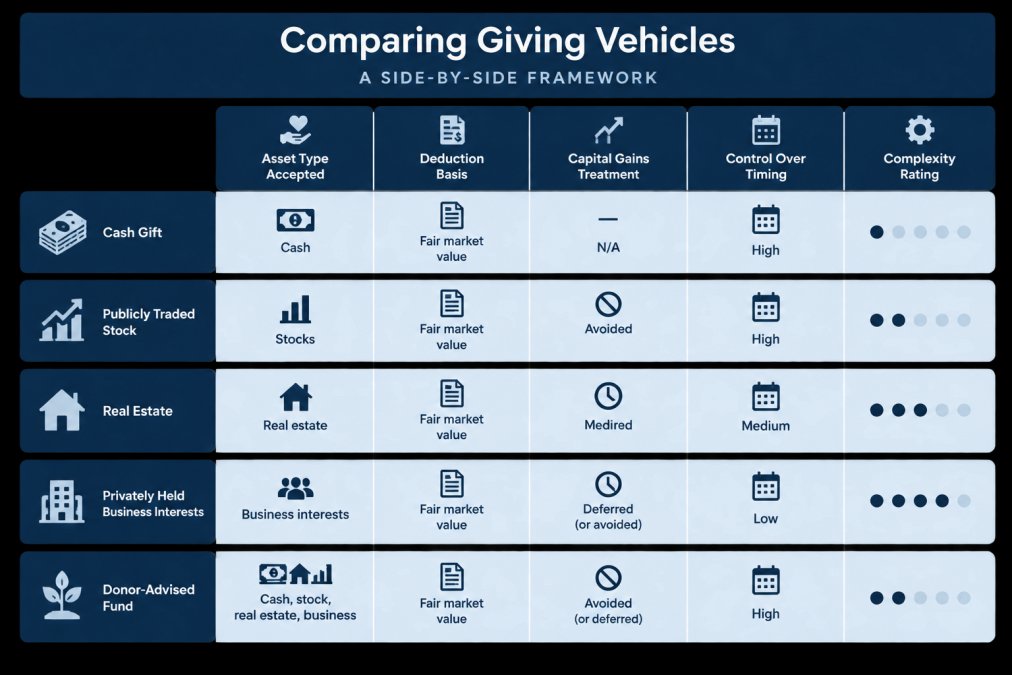
| Vehicle | Asset Accepted | Deduction Basis | Capital Gains Treatment | Control Over Timing | Complexity |
|---|---|---|---|---|---|
| Cash gift | Cash | Amount given | Not applicable | Immediate | Low |
| Publicly traded stock | Long-term holdings | Fair market value | Appreciation generally avoided | Immediate | Moderate |
| Real estate | Property | Fair market value | Appreciation generally avoided | Delayed by transfer | High |
| Private business interests | Ownership stake | Appraised value | Varies by structure | Delayed by appraisal | High |
| Donor-advised fund | Cash or assets | Amount contributed | Depends on asset given | Flexible grant timing | Moderate |
A donor-advised fund is a giving account held at a public charity. You contribute, take a deduction for the contribution, and recommend grants over time.
For a related angle on timing and vehicles, our article on charitable giving strategies for retirees covers the retiree side of the same questions.
Documentation, Recordkeeping, and Working With Your Advisors
Records are where good intentions meet the paperwork. A deduction generally needs support: a written acknowledgment from the charity, a bank or brokerage record, and an appraisal where property is involved. The IRS substantiation rules are specific, and a canceled check alone often is not enough.
The sequence matters, because some steps generally need to happen before the transfer, not after.
A Step-by-Step Donation Process
- Confirm the recipient’s status. Verify that the organization is a qualified 501(c)(3) and that it is eligible to receive the type of asset you have in mind. Some charities generally do not accept non-cash or illiquid gifts. The IRS Tax Exempt Organization Search is a publicly available tool for checking an organization’s status.
- Decide which entity is giving. Confirm whether the gift comes from the business or from you personally, because that choice generally determines which return claims the deduction and which limits apply.
- Choose the asset and check holding period. For appreciated property, the holding period generally matters to how the gift is treated. Long-term holdings are typically treated differently from short-term holdings.
- Obtain a qualified appraisal where required. For certain non-cash gifts, a qualified appraisal is generally part of the process, and the appraisal date and the transfer date generally need to align. The appraiser’s qualifications and the appraisal’s contents are specified in IRS guidance, which should be reviewed before engaging an appraiser.
- Complete the transfer and document the timing. For securities, the transfer date is generally the date the shares leave your account, not the date you decide to give. For private interests, the effective date is generally set by the assignment documents.
- Collect the written acknowledgment. A contemporaneous written acknowledgment from the charity is generally required for gifts of $250 or more under IRS rules, and it typically needs to describe the gift and state whether any goods or services were provided in exchange (Charitable contributions: Written acknowledgments). Confirm current thresholds with the IRS or your tax professional.
- File the right forms. Non-cash gifts above certain thresholds generally call for additional reporting. IRS instructions describe the forms that may apply and the situations that trigger them, so confirm the current requirements before filing.
- Keep the file together. Store the acknowledgment, transfer record, appraisal, and a note on which entity made the gift in one place, keyed to the tax year.
A Simple File for Each Gift
- Charity name and 501(c)(3) status confirmed
- Written acknowledgment received
- Payment or transfer record saved
Working With Your Advisors
This is also where a coordinated team helps. Your CPA generally sees the return side and the forms; your attorney generally sees the entity documents, transfer restrictions, and any assignment mechanics; a qualified appraiser generally sees the valuation.
We work with owners on how giving fits into a wider plan, and you can meet the professionals who can help you pursue your goals or schedule a meeting with our team to talk through your situation.
Building a Giving Plan That Fits Your Business and Your Goals
Start with goals, not tax forms. Ask what you want to support, over what timeframe, and from which pocket.
- Simple, recurring gifts often suit cash.
- Concentrated appreciated positions often suit asset gifts.
- Lumpy income years often suit a donor-advised fund and bunching.
Write it down. A one-page giving plan, reviewed each year, beats a December scramble.
Tax rules change, and outcomes vary by individual circumstances.
Giving well takes more than generosity. It takes a plan that fits your entity, your assets, and your timeline.
*This content is for educational purposes only and is not intended as personal tax, legal, or investment advice.
Frequently Asked Questions
How might a business donation differ from a personal charitable contribution?
A business donation is generally made by the entity and deducted at the entity level, while a personal contribution is claimed by the owner on an individual return. The two follow different deduction limits and documentation rules, and the same dollars are generally not deducted twice. Business owners often coordinate both: the company gives from its own account, and the owner gives personally from personal assets. Keeping the records separate helps your tax preparer treat each gift correctly, and outcomes vary by entity type and individual circumstances.
What records might a business owner keep for charitable contributions?
For cash gifts, a bank record or written acknowledgment from the qualified charity is commonly retained. For property gifts, records of fair market value, the method used to establish it, and the charity's written acknowledgment are generally kept, and noncash gifts above certain thresholds may call for additional appraisal documentation under IRS rules. Store receipts, acknowledgment letters, and appraisals with the year's tax file. Because recordkeeping requirements can change, confirm current requirements with the IRS or your tax professional before filing.
Might donating privately held business interests be an option before a sale?
It may be worth examining, though the practical constraints are real. A charity generally needs a way to convert an illiquid interest into usable funds, so valuation, transfer restrictions in the operating agreement, and buyer acceptance all matter. Some owners explore gifts of interests ahead of an exit so the charity, rather than the owner, holds the appreciation. Tax rules change, and outcomes vary by individual circumstances, so this is a conversation to have with your tax and legal advisors well before a sale process begins.
Should I consider a donor-advised fund for year-end giving?
A donor-advised fund, often called a DAF, is a giving account held at a public charity. You generally contribute assets, may take a deduction for the contribution if you itemize, and recommend grants to qualified 501(c)(3) organizations over time. Owners sometimes use a DAF to bunch contributions into one tax year while spreading grants across several years. It may suit donors who want to separate the timing of the gift from the timing of the grants, though the fund sponsor sets its own rules and tax treatment varies by individual circumstances.

Ready to Take The Next Step?
For more information about any of the products and services listed here, schedule a meeting today or register to attend a seminar.
